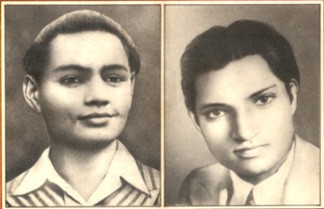
The first and foremost populist duo music composers: Husnalal Bhagatram
-Satish Chopra
‘Chup chup kharey ho jaroor koyee baat hei, pehli mulaqaat hei jee pehli
mulaqaat hei’
sung by Lata Mangeshkar & Premlata for film ‘Bari Behan’ in the year 1949 was
certainly one of the most popular melodies of its time.
I still remember, during my childhood days, open air evening theatre and
‘Ramlila’ were the most conventional media of entertainment for practically all
sections and class of the society. Before the start of the show, there used to
be musicians, who kept the waiting audience occupied with some popular melodies
from films or otherwise. And, invariably every day there used to be one song-
‘Chup chup kharey ho____’.
More than fifty years have since passed. Lata Mangeshkar sang thousands of her
songs and made a number of records. The name of co-singer Premlata can merely be
found in a few nostalgic gramophone records, those even if available cannot be
played as the desired pins for 78 rpm record players are not in use. The music
listening systems have been replaced by totally different concepts.
But, the fact remains that as and when the melody is being played; the young
listening young lad cannot resist by asking her or his grand parent, as to who
composed such an enthralling melody and is it the same Lata Mangeshkar who sang
‘Didi tera dewar diwana’; the popular song of much later years, but has
fast faded away and is no where in listening. Why there is no good music of
fifties and sixties in the air. The reasons are many!
Amongst a large number of initial music composers, who shaped the destiny of
Lata Mangeshkar, one of the foremost composers were duo- Husnalal Bhgatram. The
duet ‘Chup chup kharey ho’ was certainly one such song, which was
composed by Husnalal Bhagatram, who commenced their music journey with film
‘Chand’ (1944) starring Begum Para & Prem Adib. Its song- ‘Do dilon ko ye
duniyan, milnein nahin deti’ (sung by a totally unknown Manju) became an
instant success.
The other notable endeavor followed was ‘Pyar ki Jeet’ (1948) starring Suraiya &
Rehman was a musical super-hit. Some of the songs of singing-star Suraiya-
‘Tere nainon ne chori kiya, mera chhota sa jia, o pardesia’, ‘O door jaane
waley’ & ‘Koyee dunian mein hamaari tarah’ are still considered as her
favorites. The beauty of virgin tonal quality of voice of the singer- explored
by the composers- in these melodies is indeed superb.
Then there was an all time popular song of Mohd Rafi in this film- ‘Ik dil
key tukre hazaar hue koi yahan gira’. Also, there were, of course some
fascinating duets sung by Surinder Kaur, the melody queen of Punjab ; Meena
Kapoor and Ram Kamlani.
The film- ‘Badi Behan’ released in the year 1949 was a class in the history of
Indian cine music. Besides the most popular song- ‘Chup chup kharey ho____’
just have a glance at other seven numbers- ‘Wo pass rahein ya door rahein’,
‘Tum mujhko bhool jaao ab hum naa mil sakeinge’, ‘Likhnein waley ney, likh dee
meri taqdeer mein barbaadi likhnein waley ney’ & ‘Bigree bananey waley, bigree
banaa dey’ (Suraiya) and ‘Muhabbat ke dokhe mein koyee naa akey’
(Mohd Rafi). And; the virgin and simply heart throbbing Lata numbers are simply
great. In ‘Chaley janaa nahin’ and ‘Jo dil mein khushi ban kar ayey’
Lata was perhaps at her best and there could not have been a better return
gift to the composer- Husnalal on her twentieth birth day (Lata was born in
1929). The utterance coming straight from the singer’s heart, at times makes the
listener cry, as an outcome of eternal pleasure. The quality of a diamond-cutter
in master violinist Husnalal in particular can be visualized through these two
everlasting melodies of Lata Mangeshkar. The Punjabi style dholak played
by the musician, Shanker (of Shanker Jaikishan duo) was again a notable
landmark.
In view of the grand success of music of ‘Bari Behan’; immediately there after
Shanker Jaikishan formed the team for Raj Kapoor’s all time great film-
‘Barsaat’, replacing Ram Gangoli. In all time great melodies of ‘Barsaat’ we can
very well observe the glimpses of instrumentation of the mentors of Shanker. The
playing with excellence dholak and violin in particular was the soul of its
immortal melodies. Just listen to some its songs
‘Jiya beqraar hai’, ‘Patlee qamar hai’ &
‘Barsaat mein___’. The touches of
dholak in practicall all the numbers is simply outstanding. And then violin in
another song- ‘Mujhe kisi se pyar ho
gaya___’. Thus, another duo music composers created a chapter in the history
of Hindi cine music. Consequently, we cannot overlook, the vital training
Shanker had from his genius mentors- Husnalal Bhagatram.
Husnalal Bhagatram composed music for fifty films and created some soul
throbbing melodies. A few of their memorable numbers include- ‘Teri is do
rangee duniyan mein’ (Lata)- film ‘Sawan Bhadhon’- 1949; ‘Lut gayee
ummidon ki dulian’ (Lata) and ’Hei kaam mohabbat ka fariyaad kiyey janaa
(Rafi)- film ‘Jaltarang’- 1949; ’Dil hi to hei jo tarap gayaa’ (Lata)
–film ‘Aadhi Raat’-1950; ‘Chhota sa fasanaa hei terey merey pyar ka’
(Lata & Rafi)-film ‘Birha ki Raat’-1950; ‘Mujhse ye keh rahee hei taqdeer ki
lakirein’ (Geeta Roy & Shamshad), ‘Tootey huey dil se morey awaaz ye
aayee’ (Rafi), ‘Agar dil kisi se lagaya na hotaa’ (Lata)- film
‘Gauna’-1950; ’Dil le ke dil diya hei, ehsaan kya kiya hei’ (Lata &
Rafi)- film ‘Stage’-1951; ‘Mohabbat ki hum chot khhayey huey hein’ (Talat
Mehmood)- film ‘Farmaish’-1953; ‘Wo paas bhi rehkar paas nahin, hum door bhi
rehkar door nahin’ (Lata)- film ‘Afsanaa’- 1951; ‘O parwaney, shamma ko
apni ruswa na karna’ (Suraiya)- film –‘Shamma Parwana’-1954; ’Aye meri
zindagi tujhey dhundhun kahan’ (Talat Mahmood)- film ‘Adal-e-Jahangir’- 1955
‘Manwa mein pyar doley’ (Mukesh & Zohra) –film ‘Sartaj’-1950; ‘Yaad aa
rahaa hei dilko bhoola hua fasanaa’ (Suraiya)-film ‘Amar Kahani’- 1949. .
A glance at the profile of duo- Husnlal Bhagatram. They were the younger bothers
of Pt Amarnath-who himself was a musician of eminence and died young. He was
also associated with the all time great music of film ‘Mirza Saheban’ (1947)
starring Noorjehan & Trilok Kapoor). Both the bothers -Husnalal (born- 1920) and
Bhagatram (born-1914) -had their initial music training under the guidance Pt
Amarnath and thereafter from Pt Dilip Chand Vedi, a highly respected personality
in the field of classical music.
Husnalal’s zest for learning of violin took him to Ustad Bashir Khan. The beauty
of command over violin can be seen in different compositions of duo’s songs in
various films. In his personal life as well, the first passion of Husnalal was
classical playing of violin. A day before his demise, he played classic violin
at yearly ‘Harballabh Music Festival’ at Jullundhar. His favorite raag was
‘Malkauns’.
More than an ardent composer, he was a dedicated violist. His favorite raag was
Malkauns. In giving
shape to Lata Mangeshkar’s tonal cord for a song, Husnalal used to play the tune
on violin. Years after his demise, I was given to understand by Nirlmalaji, his
beloved wife that before going to sleep, he used to invariably play violin, what
ever may be the time.
As stated, the duo (along with their elder brother, Pt Amarnath) composed some
admirable melodies for Noorjehan for the film ‘Mirza Saheban’ (1947)- ‘Kya ye
tera pyar thaa’, ‘Aajaa tujhe afsanaa judai ka sunayein’ (solo); ‘Haath
seeney pe jo rakh do, to karaar aa jayey’, ‘Tum aankhon se door huyee, neend
aakhon se door’ (with G.M. Durrani). The list of memorable songs of
Noorjehan- whether sung in undivided India or later in Pakistan- is certainly
incomplete without these fabulous numbers.
If a collection of all time great film duets (sung in male & female voices) is
prepared, it will be predominantly incomplete without incredible- ‘Sun merey
sajnaa, dekhoji mujhey bhool na janaa’- based on raag Pahari and sung
by Lata Mangeshkar & Mohd Rafi for film-‘Aansoo’ (1952). Due to length of the
song, it was recorded on both sides of a 78 rpm record. Just listen to the
opening notes, sung by Lata Mangeshkar –the taan in singing word
‘Saajnaa’. The quality of flute and drum playing. The pauses in the vocal
articulations, the delivery of lyrical dialogues mixed with deep feelings,
in-between remarkable touches of shehnai, fascinating style of rendering
of words bhool and rooth by Lata; creating a unique soul stirring
impact on the listeners’ head and heart.
Kishore Kumar sang just two songs for Husnalal Bhagatram for the film ‘Kafila’
(1952). Simply have a note of his fascinating numbers, when he sings -‘Wo
meri taraf yun chale aa rahein hein’ and also ‘Dil lekey dil diya hei’
(with Lata).
In B.R. Chopra’s maiden film ‘Afsana’ (1950) music was composed by the duo. In
this film Lata sang a classic number- ‘Wo
paas bhi reh kar paas nahin, hum door bhi rehkar door nahin’ and ‘Abhee
to mein jawan hoon’ which is considered by some a better than the earlier
version of Mallka Pukhraj.
The chapter on Husnalal Bhagatram will be certainly incomplete, if a mention is
not made to -‘Suno suno aye duniyan walo, Bapu ki ye amar kahani’,
which was recorded after the demise of
Mahatma Gandhi. The singer-in- making 24 years old Mohd Rafi became a
celebrity overnight with this recording. The lyrics were written by Rajinder
Krishan and composed by the duo within a record time of just 24 hours, soon
after the sad demise of Mahatma Gandhi, father of the Nation. More than a
million copies of a set of two 78 rpm discs of this recording were sold within
one month. In a way, during those days, who so ever owned a gramophone, supposed
to have bought these two records.
What better popularity in the annals of music history- film or otherwise- one
can expect. However, the destiny unfolded another event. The complexities of
relationships and consequent discard by the industry, compelled Husnalal to
leave Bombay and settle in a large disputed compound in commercial Paharganj
area of Delhi for his remaining short span of life.
In Delhi, he taught music to his music loving disciples. nstead of charging any
fee, at times he offered them meals and tea. He, also performed violin recitals
on All India Radio and at other renowned concerts.
On the chilly morning of 28 December, 1968 he went out for his routine morning
walk and had a cardiac arrest on the way. He fell down at nearby Gole Market
vicinity and was taken to the then Willington Hospital (presently RML) where he
was declared as –“an unknown body brought dead.”
The fate of his elder brother Bhagatram was no better. For his survival, he
worked as a mere musician with different composers. He too died unsung in the
year 1973.
-Satish Chopra, BA/26B Ashok Vihar-I, Delhi-110052 # 8802805055/27134229
Email: satishchopra@rediffmail.com