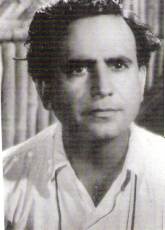
The genius of film-making named:
Kidar Sharma
A painter, story-writer, poet, photographer, lyricist, dialogue-writer,
director, editor, producer and above all a Masters in English literature from
Punjab University; the genius of the last century cannot be other than - the one
and only - Kidar Sharma.
A life which was a complete replica of distress, neglect, shattered economic
conditions and mental agony in his early life; could not discourage him
from his will to join films; which was his first and foremost passion.
The film ‘Pooran Bhagat’ produced by New Theatres of Calcutta and directed by
Devaki Kumar Bose in early 1930s made some perpetual impact on his psyche.
The tiring rail journey in third class compartment from Amritsar took young
Kidar Sharma to a totally unknown place called Calcutta in search of Devaki
Kumar Bose. After repeatedly tried to enter the gates of the studio of New
Theatres, the then mecca of film industry and forbidden by the watchman at the
gate; Kidar Sharma approached two Punjabies namely Prithviraj Kapoor and Kundan
Lal Saigal (who were associated with New Theates) for their help for the desired
introduction to Devaki Kumar Bose, the famous director of the film ‘Pooran
Bhagat’.
As destiny would have it, Saigal
introduced young Kidar to D.K.B. (as Devaki Kumar Bose was popularly known)
through Durga Khote, the well known face of cinema of those days. This proved to
the beginning of a golden chapter in the annals of the history of Indian cinema.
Thereby, commenced the journey of Kidar Sharma in films as a still photographer
with ‘New Theatres’.
Amongst his large number of fascinating still photographs, there is a prized
portrait of young Kundan Lal Saigal with a solo-hat, which has been published
time and again in different magazines and journals. He remarkably utilized the
art of still photography in his directional attempts. One such example can be
visualized in one of his immortal films viz ‘Jogan’ wherein close-ups of
emotionally charged Nargis and Dilip Kumar portray some classic examples of
human sentiments.
Kidar Sharma in his early days, while struggling for his livelihood used to
paint the portraits of religious idols, luminaries and film personalities. A few
of such portraits he painted and made sketches were those of Uma Shashi, Kanan
Devi, Pahari Sanyal, Robindranath Tagore, Sarat Chandra Chatterjee and in his
later days that of Jawahar Lal Nehru.
At times, he also pasted film-posters on the walls of Calcutta.
The lyricist in Kidar Sharma needs no introduction to the film-music lovers. A
list of some of his most unforgettable
lyrics include- ‘Balam
aye baso merey man mein’, ‘Dukh key ab din beetat naahin’, ‘Deewana hoon’, ‘Hum
apna unhein banaa na sakey’, ‘Jagat mein prem hi prem bharaa hei’, ‘Kya humney
bigaraa hei, kyuun humko satatey ho’, ‘Miskuratey huyey yun aankh milaya na
karo’, ‘So jaa rajkumari’, (sung by Kundan Lal Saigal). ‘Khayalon mein
kisee key is tarah aya nahin kartey’, ‘Teri duniyan mein dil lagta nahin’,
‘Mujhey such such batado, kya’, ’Sun bairee balam mat bol, ib kya hoga’, ’Sapna
ban saajan aye’, ‘Muhabbat ke maron ka’, ‘Farishton ki nagri mein main’, ‘Gokul
se gayey girdhari’, ‘Kabhee
tanhaiyon mein yun hamari yaad ayegee,’ and ‘Ankhon mein teri yaad liye
jaa raha hoon mein’.
During
the days of his economic crisis, Kidar Sharma wrote some of Saigal’s immortal
non-film songs for a petty sum of Rupees Five each (viz ‘Panchhi kahe hot
udas’, ‘Suno suno hey krishan kala’ and ‘Shamma ka jalna hei’).
It may be observed that most of his lyrics are generally worded at a distinct
ease, with simplicity, a unique style which is
close to dialectical prose, spontaneous, effortless
and apparently coming from the core of
his heart. For instance, if it is ‘Dukh ke ab din beetat nahin’ or
‘Mujhey such such bataa do, kya’ and
’Khayaoln mein is tarah aya nahin katrtey’. There are a large number of
such songs written by the maestro.
It
appears that saying of Mathew Arnold that- ‘Poetry is spontaneous overflow of
thoughts’- has come alive from the pen of Kidar Sharma.
The dialogue and a screen-play writer’s role of Kidar Sharma (for some of his
films viz ‘Devdas’,
‘Vidyapati’ and ‘Jogan’) must be appreciated. Then there were films like
‘Suhagraat’, ‘Shokhian’, ‘Gauri’, ‘Hamari Yaad Aayegi’ and ‘Bawre Nain’ etc.
Kidar Sharma directed a film -‘Chitralekha’ starring A.S. Gyani and Mehtab in
the year-1941. It was based on Bhagwati Charan Verma’s (Hindi laureate) all time
great novel having a classic story line and a conflicting theme. In this film as
well the theme song ‘Tum jao jao bhagwan bane’ sung by Ramdulari was
written by Kidar Sharma. The music for the film was composed by Jhande Khan (the
mentor of Naushad). Kidar Sharma for the second time directed another
version of -‘Chitralekha’ in 1964, starring Meena Kumari and Pradeep
Kumar. Sahir wrote the theme song ‘Sansaar sey bhagey phirtey ho’
composed by Roshan for Lata Mangeshkar for this vesion.
Nargis’ role in film ‘Mother India’ produced and directed by Mehboob Khan is
generally considered as her best. However, Nargis could not restrain herself,
when in one of the interviews she said- “Though I touched my best in the
movie Mother India___yet, I think I gave my best ever performance in
Jogan”. It was perhaps due to the reason that Kidar Sharma, the
producer-director of film ‘Jogan’, who could extract better
performance from the actor than Mehboob Khan in ‘Mother India’.
A hard task master, having a deep understanding of mental conflict of human
nature and above all an uncompromising character as a director; Kidar Sharma
resigned from ‘New Theatres’ of Calcutta when he could foresee that his
conviction and logical determination was getting hurt. This accelerated his
financial problems. He therefore moved to Bombay alongwith his lifelong friend
Prithviraj Kapoor, where he was introduced to Seth Chandulal Shah of Ranjit
Movietone.
At Ranjit, he scripted and directed his first film ‘Aulad’ starring A.S. Gyani
and Romola, which was an off-beat dealing with human problems. The film marked
the beginning of new wave cinema.
In view of the fact that Kidar Sharma had a wonderful sense of lyrics and music,
right from the days he wanted to enter the film-world, and
inspired by musical-hit film ‘Pooran Bhagat’ (1933) in which Saigal sang
some heart-throbbing melodies viz ‘Bhaju mein to bhav se shree girdhari’,
‘Ausar beeto jaat pranee tero ausar
beeto jaat’ and ‘Sumiran kar piya raam naam’,
he made Snehal Bhatkar
to provide the music of his film ‘Suhagrat’ (where he also introduced Geeta Bali
as heroine). He as well brought to limelight Roshan, music director for his film
initially for film ‘Neki aur Badi’ and thereafter for ‘Bawre Nain’.
However, looking to the story-line of one of his all time great films- ‘Jogan’;
he instead chose Bulo C. Rani (a former assistant to genius Khemchand
Prakash) for its music. The voice
quality, choked with emotions of Geeta Roy (later on Geeta Dutt) in this film
was and will remain immortal in the annals of history of cine-music. Geeta Roy
was perhaps at her best in ‘Jogan’ singing,
the bhajans of Meera. While listening to these sublime melodies;
at times, the singer reminds the bhajan singing of other greats like
Juthika Ray and M.S. Subhalakshami.
Prithviraj Kapoor, the father figure of Indian cinema (affectionately known as
‘Papaji’) preferred to leave his eldest son Raj Kapoor for training with the
hard task master Kidar Sharma. Thus Raj became his assistant.
Then came a day, when Kidar Sharma decided to launch Raj Kapoor as a hero in his
next film- ‘Neelkamal’ in the year-1947 along with another newcomer as heroine
called Madhubala (known as Baby Mumtaz). Though this was against the wishes of
the producer Seth Chandulal Shah; yet, conviction and firm determination in the
head and heart of Kidar Sharma could not deter him from making this film and
creating legendary actors. Besides, these illustrious stars, he also introduced
Geeta Bali (film-‘Suhagrat’), Mala
Sinha (film- ‘Rangeen Ratien’) and brought to limelight Tanuja in his film
‘Hamari Yaad Aayegi’.
The haunting melodies of yester years composed by Roshan for ‘Bawre Nain’
‘Khayalon mein is tarah aaya nahin karte’- sung by Geeta Roy and
Mukesh, ‘Teri duniyan mein dil lagta nahin’-sung by Mukesh and ’Sun
bairi balam mat bol’ and ‘Kyun mere dil mein’ -sung by Rajkumari will
be remembered by the music lovers not for years but for ages.
In myriad roles of a story-writer, lyricist, screen-play writer,
dialogue-writer, editor, photographer or director; Kidar Sharma in his career in
the film industry was in one way or the other, associated with some immortal
films viz ‘Devdas’. ‘Vidyapati’, ‘Aulad’, ‘Mumtaz Mahal’, ‘Zindagi’,
‘Vishkanya’, ‘Jogan’, ‘Bawre Nain’, ‘Suhagraat’, ‘Gauri’, ‘Shokhian’, ‘Neki Aur
Badi’, ‘Rangeen Ratein’, ‘Pyase Nain’, ‘Mumtaz Mahal’, ‘Chitralekha’,
‘Hamaari Yaad Aayegi’ and many more.
The list appears endless.
In the later half of his career, Kidar Sharma was associated with Children Film
Society and produced and directed some classic films like- ‘Jaldeep’,
‘Chetak’ and ‘Dunia Ek Sarai’. The film -‘Jaldeep’ won an award at the
Cannes Film Festival.
“Kidar Sharma died in 1999, dreaming till the last of the films he wanted to
make. He always had a subject ready, or a script waiting to be financed. It
never happened. And the strange it may seem, he was, I think, the only
film-maker who was not adequately honoured in this country in his lifetime”-
noted critic Saeed Akhtar Mirza has pertinently observed after the maestro’s
demise.
Award or no award! In the present
day over-all scenario in our country, now that every one understands, how the
capability of a person is being evaluated; thereby, it is lesser said the
better. Yet, the fact remains that as and when the history of Indian cinema will
be written, one name amongst the greats of ‘Silver-Screen’
will be that of –Kidar Sharma; and what he wrote and Mubarak Begum
recited ‘Kabhi tanhaiyon mein bhee, hamari yaad aayegi’ for his film
-‘Hamari Yaad Aayegi’ will find its meaning for various
reasons. It will also continue to haunt millions of lovers and critics of
Indian cinema.
-Satish
Chopra, BA/26B Ashok Vihar-I, Delhi-110052 #011-27134229/27450869
Email: satishchopra@rediffmail.com