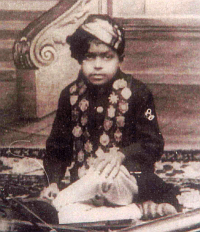
-Satish Chopra
‘Yun naa reh reh kar hamein tarsaaiye’
and
‘Hairat se tak rahaa hei jahane wafa
mujhe’ these two ghazals of
Master Madan recorded at the
tender age of eight years, on a 78 rpm gramophone record
is a priceless
collection of yesteryears’ immortal music.
Anyone with even a passing interest in music is familiar with these two Sagar
Nizami’s ghazals, sung by the extraordinary child prodigy- Master Madan, who
died at an age of just less than fifteen.
These two ghazals have certainly retained the magic even after a gap of more
than sixty five years, which is evident from a collection of ten CDs released by
HMV by the title- ‘Ghazal Ka Safar’. This collection includes these two ghazals
of Master Madan, along with recordings of majority of eminent ghazal singers of
the previous century. The collection was edited by Jagjit Singh, the famous
singer.
Till the end of previous century, just these two songs of Master Madan were
available. However, after strenuous efforts by some ardent music collectors, we
could trace six more of his fabulous renderings. Thus, making available
collection of his perfectly modulated songs to
eight.
A few lines about the life of the celebrity. Master Madan was born on 26
December, 1927, in an orthodox Sikh family in a village of Punjab called-
‘Khankhana’, built and named by Abdul Rahim Khankhana in Jallandhar District.
Abdul Rahim Khankhana was one of the
nauratans (courtiers) of Emperor
Akbar. Besides a warrior, an eminent Hindi & Arabic poet-philosopher, he was
popularly known as ‘Rahim’.
Master Madan’s father Sardar Amar Singh was in the service with Education
Department and his mother Puran Devi
was a religious lady. She too died young
in the year 1942
The child prodigy started singing at the tender age of three and quickly became
a craze all over India. His astonishingly mature voice left a deep impression on
the listeners in general and devout Sikhs in particular. Listen to his
captivating rendition- ‘Chetna hei to
chet ley’ a hymn (sahabad) of Guru Teg Bahadur Saheb-
which is a classic example of his excellent understanding of thought and
feel of whatever he sang. Shanti Devi,
his elder sister had revealed that- he always carried a portrait of Guru Nanak
wrapped in silk, a rosary an a‘gutka’ (abridged holy Granth) where ever he
went.
He gave his first public performance at the age of three and a half years at
Dharampur Sanitorium (Himachal Pradesh) where he enthralled the audience by
singing in dhrupad style of Indian
classical music. According to Shanti Devi; the listeners were spell-bound with
his command over laykaari and
surtaal (rhyme and rhythm).
The young lad concluded
the recital
with a devotional composition
‘Hey sharda naman karoon’ in
raag
mishr kafi.
The critics hailed it as the beginning
of a fabulous era.
After the conclusion of this captivating recital, he was bestowed with a gold
ring, a shawl and a gold medal. His first successful performance made him a
celebrity. There was a grand news coverage in the print media. Some of such
paper clippings are still available with Ravinder Kaur, the niece (bother’s
daughter) of Master Madan at Butail Building, Shimla.
Overnight, the identity of the genius spread like fire all over the
music fraternity of the country. After his grand success, he commenced
giving performances along with his elder brother Master Mohan. Every where he
was in demand. Though, posters portrayed the photographs of both the brothers,
there used to be a special mention
of mesmerizing singing of Master Madan.
The maestro commenced his training in music at the age of seven years, under the
able guidance of Pt Amar Nath, a great musician and elder brother of composer
duo- Husnalal & Bhagatram. He had composed music for film ‘Mirza Saheban’,
wherein Noorjehan sang some of her captivating numbers. The two ghazals
referred to above were also composed by Pt Amar Nath.
.
Master Madan’s elder brother Master Mohan, who was in Shimla, also used to sing
and played violin. This was the time when the legendry singer K.L. Saigal too
was in Shimla. Very often, Saigal used to bring his harmonium to their home-
‘Butail Building’ Lower Bazar, Shimla- for his singing and his brother played
violin..
In 1940 Mahatma Gandhi visited Shimla and very few people turned up at his
meeting, as most of them had gone to a concert of Master Madan.
The singing sensation was a particular favourite of the rulers of Indian states,
who conferred many medals on him, which he invariably wore at his recitations.
He was always in demand for his singing. Thereby his family was thrilled, as he
used to bring lot of money and valuable presents.
But, this took its toll. In view of excessive strain under which the young boy
lived and performed, his health began to suffer. He would complain of exhaustion
and low fewer. Sadly, he was not properly taken care of and provided adequate
medical attention. When at a later stage, he was taken for an examination, he
was found to be beyond recovery. The diagnosis was a slow poison that had
affected his vital organs. The genius with his immortal voice died in Shimla on
5 June, 1942 several months short of his 15th birthday. He was
cremated wearing all his medals.
There had been many rumours about the cause of his death. One such gossip went
that at one time when he was performing at Ambala, a local singing girl had
invited him to her Kotha and gave him
a doctored paan (betel leaf). Another
said that at Radio Station Delhi, he was given mercury in his drink by a jealous
performer. Yet another was that in Calcutta, after his sensational concert at
which he sang a thumri- Bintee suno meri,
someone gave him a slow-acting poison in his drink. It was noticed in
retrospect that he never recovered his voice after that particular performance.
.
However, the fact is that it was the greed of the family or envy of the rivals
that killed the child-prodigy- Master Madan, leaving behind recordings of just
eight classic classical.
Yun naa reh reh kar hamein tarsaaiye
(Ghazal)
Heirat se tak rahaa hei jahane wafaa mujhe (Ghazal)
Goree goree baiyaan (Thumri)
Mori bintee mano kanha re (Thumri)
Man ki man hi maan rahi (Gurbani)
Chetnaa hei to chet le (Gurbani)
Bagaan wich peegan paiyaan (Punjabi)
Raavi de palle (Punjabi)
One is remembered of pithy couplet from Abdul Rahim ‘Khankana’:
“Rahiman ochhey naran soun, bair bhalo na priti;
kaatein chatein swaan ke, dou bhanti
vipreet’
“Rahim let not a petty man be your friend or foe;
A dog’s lick or bite will only lead to woe”.
Satish Chopra
BA/26BAshok Vihar-I, Delhi-110052#011-27134229/8802805055
Email: satishchopra@rediffmail.com
Hairat se tak raha
hai jahane wafa mujhe - Back to text
Gori gori baiyan - Back to text
Mori Bintee mano re Kanha
-
Back to text
Man ki man hee maan rahi
-
Back to text
Chetna hai to chet le -
Back to text