The most conventional Indian music composer:
Naushad
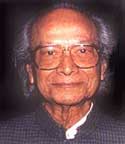
by Satish Chopra
If and when a dispassionate
history of the evolution and development of Indian film music comes to be
written, Naushad"s name will undoubtedly find a pride of place in it. And, rightly so for the contribution he has made to the field of creative
music in Hindustani films is immeasurable.
Naushad was amongst the earliest
music directors to recognize the limited range of indigenous musical instruments
for modern orchestration and to introduce Western instruments into Indian
orchestras. And yet he was one of the few composers on the film scene, who had been critical of just
copying the Western music.
The sixty or sixty plus odd films
in which this brilliant music director has given music provide ample evidence of
the richness and variety of his repertoire ranging from the modern and folk type
of music to the light classical and classical.
Naushad
had been a legendary figure in the Indian film world for nearly three decades and the secret of his unparalleled success more than anything
else is the meticulous care he displayed in the execution of his work and his
zest for excellence.
Naushad, son of Wahid Ali a
munshi in the courts, was born on 25
December, 1919 at Luchnow. He had interest in music from his very childhood, but
not much inclination towards education. Against the wishes of his parents, he
ran away from his home town and arrived in Bombay in 1937.
In
Bombay, he came across Ustad Jhande Khan, the film music composer and became his
assistant for the film "Sunehree Makaree" and composed his first song
"Kyion
ye dil deewana hei, akl se beganaa". But, unfortunately the film was not
released. Thereafter, he got a chance of assisting another composer -Mushtaq
Hussain Khan for films "Nirala Hindustan" and "Bagbaan" in the year-1938 and
film "Pati-Patni" in the following year.
In the
year-1939, Naushad joined reputed film production company - Ranjit Movietone, as
an instrumentalist to music directors Manohar Kapoor and Khemchand Prakash for
films - "Aakhein" & "Ghazi Salaudin" respectively.
Mahohar
Kapoor was music composer for Punjabi film - "Mirza Saheban" produced by D.N.
Madhok. While the film was in
making, Madhok recognized the talent of Naushad. Consequently, he recommended
name of Naushad to Seth Chunnilal Shah the proprietor of Ranjit Movitone, for an
independent charge of music for his next film - "Kanchan".
Naushad
composed his first song for film - "Kanchan"
- "Bataa do mujhey, kuan galee
gaye shyam"sung by singer-actress Leela Chitnis. But, owing to
differences, Naushad after discussing with D.N. Madhok,
left the film in-between and the music
was completed by Gyan Dutt.
D.N.
Madhok wrote story, dialogues and lyrics for film - "Premnagar" (1940) which was
produced by Mohan Bhavnani. The music was once again composed by Naushad. In the
next year, he composed music for films - "Darshan" & "Station Master".
A.R.
Kardaar produced and directed -film "Sharda" (1942). A 13 years old baby Suraiya
sang her first playback song - "Panchhee jaa",
which proved a super-hit.
Thus, a collectors" item and also name in the history of singers was created.
After
the release of "Sharda", A.R. Kardaar was deeply impressed with the performance
of Naushad. He as well
suggested Mehboob
Khan (his bother-in-law), a genius in film production the name of Naushad for
music for his forthcoming films. This proved to be a turning point in his
career.
Mehboob
Khan produced some classic films like "Aurat" (1940) and "Roti" (1942) and some
immortal music for these films
was
composed by the genius - Anil Biswas. But, owing to some financial and or ego
problems, they parted. If Anil
Biswas would have continued with Mehboob Khan, the fate of Naushad must have
been certainly different!
Naushad
composed a large number of films produced in early forties under the banner of
Kardaar production. The list of such films include - "Kanoon", "Namaste" & "Sanjog" (1943), "Pehle Aap", "Geet" & "Jeewan" (1944), Sanyasi (1945), "Keemat" and "Shahjahan" (1946), "Dard"
& "Natak" (1947), "Dillagi" & "Dulari" (1949) and "Diwana" (1952).
Some of
the noted melodies Naushad composed for Kardaar"s films -
"Ek tu ho ek mein hoon aur nadee ka kinara ho"
-Suraiya
(Kanoon), "Aan milo morey shyam sanwarey" - Parul Ghosh & G.M. Durrani
(Namaste), "Chaley gaye chaley gaye, dil mein aag laganey wale"
- Zohrabai
Ambalewali (Pehle Aap), "Suno ji pyari koyalia boley, mast jawanee doley"
- Amar & Zohrabai (Sanyasi),
"Aaj
machee hei dhoom, jhoom khushee mein jhoom" & "Afsanaa likh rahee hoon
dil-e-beqaraar ka"
- Uma Deviand"Hum the tumharey tum the hamarey" -Suraiya (Dard),
"Dil waley dil waley, jal jal kar hi mar janaa"
-"Natak", "Murliwaley murli bajaa, sun sun murli ko"-Suraiya
(Dillagi), "Tu mera chaand mein teri chandni" & "Zalim zamana mujhko tumse
chhura rahaa hei" - Suraya & Shyam and
"O teer chalaney waley__ teer
khatey jayengey"
-Lata and "Tasveer banata hoon teri khune jigar se"
- Rafi (Diwana). Besides all the 12 songs of film "Dulari" were superhit. And,
"Suhanee raat dhal chuki" - Rafi and
"Taqdeer jagaa kar aayee hoon" & "Aie
dil tujhe kasam hei, himmat na harnaa" - Lata and
"Naa bol pee pee morey
angnaa" -Shamshad
songs need a particular reference.
But,
the fact remains that the greatest Kardaar-Naushad hit was "Shajahan" starring
the greatest singer of the century, the one and only -Kundan Lal Saigal. There
were six fabulous songs of
Saigal in this film -
"Ghum diye mustaqil, kitnaa
nazuk hei dil", "Kar lijiyey chal kar meree jannat ke nazarey", "Jab dil hi toot
gayaa", "Aie dil-e-beqaraar jhoom", "Chaah barbaad karegi hamein maloom na tha"
& "Merey sapnon ki raani, ruhi ruhi, ruhi".
In the last number -"Merey
sapnon ki raani, ruhi"__"
Mohd Rafi too accompanied the singer.
In one
of his programmes broadcasted over A.I.R. (Vividh Bharti),
Naushad
observed that
on the funeral of
Saigal, his song "Jab dil hi toot
gaya"was sung as a tribute to the
legendary singer. It is a myth. As
I
discussed this particular aspect with one of the family members of the singer,
who at the outset negated such saying. And, I was given to understand that at
wee hours on 18 January, 1947 when Saigal breathed his last at Jallandhar, the
whole of Punjab was in flames, in view of the communal and partition riots. As
such, about 20-30 family members and close friends thought it most appropriate
to cremate the dead body at the erliest. Moreover Saigal died at his young age
of just 42 years. As such, there was no question of singing of song "Jab dil hi toot
gaya",
as narrated by Naushad.
In the
year 1944, Jamuna Productions, Bombay produced film "Rattan". The songs for the
film were written by D.N. Madhok, who even made the tunes of his songs by
playing his fingers on a matchbox, which was his unusual style. Music was composed by Naushad and the total cost of the film was a mere 75
thousand rupees. In view of the popularity of its all 10 songs, the film proved a smashing box office success and it ran for more than 75 weeks.
Some of
its songs viz "Akhian milaa ke, jiya bharmaa ke chaley nahin janaa", "Pardesi
balamwaa baadal ayey", "Aayee diwali aayee diwali, deepak sung naachey patangaa"
& "Rumjhum barsey badarwaa, must hawanyein aanyee"
-sung by Zohrabai Ambalewali and
"Angrayee teri hei bahanaa" & "Jhuthe hein sapney suhaney"
- sung by Manju
and "Jab tum hi chaley pardes lagaa ke thes"
- sung by Karan Dewan and
"Saawan ke baadlo, unsey ye ja kaho"
- sung by Zohra & Karan Dewan and
"Mil ke bichhar gayee akhiyan"
- sung by Ameerbai and "O jaaney waley
balamwaa"
- sung by Ameerbai & Shamkumar were super-hit. And, till date the
melodies haunt the music listeners.
Once I
was given to understand by Naushad that first year royalty from the sale of the
film"s gramophone-records -costing Rs. Two each- was over three lac rupees.
In the
films to follow, Naushad composed some memorable melodies-
"Gaaye jaa geet
Milan ke" - Mukash,
"Dharti ko aakaash pukare", "Mein bhanwara tu phool",
"Meraa dil torney waley", "Aayee sawan rut aayee" - Mukesh & Shamshad,
"Ye
zindagi ke meley, dunian mein kum na hongey", "Phir aah dil se nikalee, tapkaa
lahoo jigar se" - Zohrabai Ambalewali, -film "Mela" (1948);
"Lagan morey
mun ki balam nahin jaaney", "Panchhi bun mein piya piya ganey lagaa" - Lata,
"Na socha tha ye dil laganey se pehley" & "Chhorh babul ka ghar" -Shamshad,
"Mera jeewan saathi bichhar gaya", "Kisee ke dil mein
rehna tha, to merey dil mein kyun aaye" -
Lata & Shamshad, "Miltey hi
aankhien dil hua diwana kisikaa" & "Duniyan badal gayee"-Talat Mahmmod &
Shamshad - film "Babul" (1950).
An
amazing incident took place during the recording of music of "Babul". The singer, Talat Mehmood lighted his cigarette in the presence of the
music director, which offended or annoyed Naushad. As such, this act cost very
heavily on the singer; because in
the future course of his singing, he never got a chance to sing for Naushad.
Two
films - "Dastaan" (1950) and "Jaadoo" (1951) were unique in the career of
Naushad. In these two numbers he used Western orchestra in a remarkable manner.
Though in his later years, he always campaigned for purity of Hindustani
classical for his films. Anyhow, some of the melodies he composed were indeed
fabulous viz "Ye mausam ye tanhayee", "Aie shamma tu bataa", "Nainon mein
preet hei" - Suraiya. Besides there was a instrumental recording of orchestra
on both sides of a 78 rpm disc for film "Dastaan". This orchestral number was
played by Radio Ceylon for years together as the signature tune for their
programme - "Aap ki Pasand". Again
the memory of "Lara loo"
number for film
-"Jadoo" had a bewitching impact on the listeners.
The
film "Deedar" (1951) will be remembered for its
two numbers-
"Dekh liya
mainey kismat ka tamasha dekh liya" - Lata & Rafi and
"Bachpan ke din
bhula na dena" - Lata. Again, the quality of harmonium played while composing
the melodies was simply superb.
The
film -"Baiju Bawra" (1952) produced by Prakash Pictures and directed by Vijay
Bhatt, was another signpost in the career of Naushad. The classical based music
of this film is still alive, even after a gap of more than five decades.
How can
one forget - "Mohey bhool gaye sanwaria" & "Bachpan ki muhabbat ko dil se na
judaa karnaa" - Lata,
"Insaan bano", "O duniyan ke rakhwaley" & "Mun
tarpat hari darshan ko aaj" - Rafi,
"Jhuley mein pawan ke aayee bahaar" &
"Tu ganga ki mauj, mein jamuna ki dharaa"Lata & Rafi and
"Door koyee
gayey dhun ye sunayey terey bin chhalia rey" - Lata, Shamshad & Rafi. The
alluring jaltarang
support with "Jhuley
mein __"
was indeed unique and captivating.
Again,
there were two numbers of Ustad Amir Khan, the classical
maestro of Indore
gharana -
"Tori jai jai ho kartaar" & "Dhanan dhanan barso"
and yet
another masterpiece -
"Aaj gaawat
mun mero jhoom ke" - a duet by
Pt D.V. Paluskar & Ustad Amir Khan. Interestingly, this classical duet was
recorded as the playback for film"s hero Bharat Bhushan (Baiju) & Surendra
(Tansen) respectively. Since Surendra was himself an eminent singing-star; as
such, while the film was in making, he could not digest, as to why some one else
will sing his playback. However, when he learnt that Ustad Amir Khan will sing
for him, he became speechless and felt highly elevated. .
The
film "Baiju Bawra" as well, in view its popular music, completed more than 75
weeks of its screening. On its grand success, a function was organized at
"Broadway" theatre, located in Dadar, Bombay to facilitate Naushad, the music
director and architect for its success. The maestro was called at the theatre"s
stage to say a few words about the music and success of his career.
Naushad
candidly recalled the event and told me that he was totally charged with
emotions and completely short of words. Consequently, he could merely utter-
"Dosto, is theatre ki footpath se lagee seerdion se is stage tuk aaney mein mujhey soleh saal ka wakt lagaa hei.
Mujhey aaj bhi yaad hei jab mein apney shahr Luchnow se Bambai aayaa tha, to
mein is theatre ki seerdion par
soyaa kartaa tha". (Friends, I have taken sixteen years to reach this stage from the stairs of this theatre. I still remember that when I came
to Bombay from my city Lucknow, I used to sleep on the stairs adjoining the
footpath of this theatre).
With
the passage of time and due to financial constrains, Bombay"s "Broadway" theatre was converted into a shopping plaza. But, when the
theatre was being demolished; Naushad told me during my meeting with the maestro
in the 1978, that he personally went to Dadar area at the site and watched the
scene of demolition for ten minutes. He returned home and recalled the day the film "Baiju Bawra" completed 75
weeks of its screening at the Bombay"s "theatre of pride" called -"Broadway".
A
unique step in the career of the master composer was film "Uran Khatola" (1955), produced by Sunny Art Production, Bombay, starring Dilip Kumar and Nimmi. The film had an extremely poor quality
story-line, a pathetic direction, customary photography and above all nothing to depict past, present and future
about the characters portrayed in the film. But, the music of Naushad was simply
outstanding. Each of its 13
melodies composed was better than the other.
Be it orchestra used for "Mera salaam lejaa" & "Ghar aaya mehmaan", human humming created for
"Haiyaa ho haiyaa re haiya__morey
saiyyan ji utrengey paar ho, nadiya dheerey baho",
depth in the opening
notes of "Doobaa tara ummindon ka saharaa toot gaya", "Naa ro aye dil kahin
ronein se taqdeerien badalee hein", "Haaley dil mein kya kahun", the incredible use of
swarmandal in
"Sitaron ki mehfil sajee
magar tum na aayey" - all Lata numbers and
"Muhabbat ki raahon
mein chalnaa sambhal ke & "Naa toofaan se khelo" -
Rafi. The assistance of Mohd
Ibrahim in creating the entireness was complete. The film"s outstanding music
was its saving grace.
As
stated, one of the key factors for the success story of Naushad, was his
association with genius Mehboob Khan, who after his break away with Anil Biswas,
took young Naushad as music director for his forthcoming films after "Roti" in
the year - 1942. The channel of
introduction to Mehboob Khan was established by lyricist Dina Nath Madhok, who introduced young Naushad to Abdil Rashid Kardaar who as well recommended him (Naushad) to his brother-in-law Mehboob Khan.
And,
thus the success story progresses!
The perfectionist Mehboob Khan
produced a good number of films with Naushad as his music composer. The list of
such numbers include- "Anmol Ghadi" (1946), "Elaan" (1947), "Anokhi Ada" (1948),
"Andaaz" (1949), "Aan" (1952), "Amar" (1954) and "Mother India" (1957). .
"Aawaaz de kahan hei, dunian meri
jawan hei"sung by evergreen melodious Noorjehan and
Surendra is perhaps one of the most
popular melodies not only for
India, but for the entire Indian sub-continent. The voice of Noorjehan in the
song appears, as if coming out of a violin instead from her throat. After
listening to such immortal melodies, one can say
without
any hesitation that
music
cannot be bound by any kind of barriers. The song was composed by Naushad for
the film "Anmol Ghari", the maiden venture of the composer with the director and
producer Mehboob Khan. The song will be remembered till there is some music in
the air.
The
melody queen of the sub-continent, Noorjehan migrated to Pakistan after the
partition of India, which is considered as one of the biggest losses
to Hindustani cine music. Had Noorjehan stayed in India, her fate and that of
Lata Mangeshkar would have been entirely different. In the making of Lata
Mangeshkar (during her
"Golden
Era" -1948 till 1955) she was fortunate enough to have a galaxy of music composers, who were indeed diamond cutters. They not only shaped
her voice quality, but also her destiny.
The
list of names of some of such maestros includes - Anil Biswas, Khemchand Prakash,
Husnalal Bhagatram, Sajjad Husain, Naushad, Shyam Sunder, Vasant Desai, S.D.
Barman, C. Ramchandra, Shanker Jaikishan, Hans Raj Behl, Ghulam Mohammad, Vinod
and Roshan to name a few. But, composers of Pakistan (barring Master Gulam Haider, who also migrated from India and died young) could
not extract the genius out of "Mallika-e-Tarannum", the name given to
Noorjehan by Pakistan. Here, it will not be out of place to mention that there
was a complete lack of pertinent composers for the class of Noorjehan in
Pakistan.
As
destiny would have been, Noorjehan was not lucky enough to have composers which
Lata had during her singing Great.
Inspite
of the fact that the range and quality of the singing of Noorjehan was excellent (which is well evident from her priceless recordings of
undivided India), she could not or her composers create that quality of songs,
which she indeed deserved. Her god-gifted extra-ordinary melodious voice quality
was lost in loud instrumentations of Pak-music composers. On the other hand in her-pre-partition days melodies, the soul of the songs immersed in
lyrics in most of her melodies was complete, which can be observed in Naushad"s
"Aawaaz de kahan hei"
followed by most balanced instruments accompanied,
if it was violin and or any other instrument deployed.
"Ajaa, ajaa meri barbaad mohabbat ke
saharey"
was another fabulous song of Noorjehan in
"Anmol Ghari".
Again, there were"Kyaa mil gaya bhagwan", "Jawan hei
mohabbat" & "Merey bachpan ke saathi mujhe bhool na janaa"numbers. Other
than Noorjehan"s songs, there were some the fine melodies of Suraiya viz
"Sochaa tha kya, kya ho gaya; "Man letaa hei angrai" & "Mein dil mein dard basaa
layee" and Surendra"s -"Kyun yaad aa rahein hein" and Rafi"s -
"Tera khilona toota" and
Zohra & Shamshad"s - "Uran khatole pe urh jaoun, terey haath na aauon"and
there were other
unforgettable melodies in this maiden "Naushad-Mehboob Khan" film -"Anmol
Ghari".
What a
grand commencement of "Naushad-Mehbbob Khan" joint venture!
There
is not much to be commented on the subsequent film -"Elaan". But Mukesh sang
some memorable songs (his first
film with Naushad)
for "Anokhi Ada" viz
"Manzil ki dhun mein jhoomtey gaatey
chaley chalo", "Bhoolney waley yaad na aa", "Ye pyar ki batein" & "Kabhee dil, dil se takrayaa to hoga". Uma Devi (Tun Tun) as well
sang "Kahey jiya doley, kaha nahin jaye" & "Dil ko lagaa key humnein kuchh
bhi na payaa" besides songs of
Shamshad & Surendra; and Mukesh & Shamshad"s duet -"Bhool gaye kyon
dey ke saharaa"was another unforgettable number.
The
next major success was film "Andaaz" starring Dilip Kumar, Nargis and Raj
Kapoor. In this film young and upcoming Lata Mangeshkar sang for the first time
for Naushad. There were three solo and three duets of Lata and another four
marvels of Mukesh. Looking to major star-cast and also the legendary
director-producer, Mehboob Khan, it was not only a challenge for Lata but also
for the composer. This was owing to the fact that young Lata basically lacked
the understanding of Urdu accent and poetry to be sung on the playback of the
heroine - Nargis. And most important, Dilip Kumar had his reservations about the
accent of Marathi singer - Lata, besides those of Mehboob Khan.
Music
is my department and I don"t want any interference; may it be director or the
producer. I told Mehboob Saheb, when fingers were raised, as to who will be the
female singer for the playback of the heroine - Nargis? - said Naushad. This
conveyed his confidence in the singer and his conviction.
As
such, at the time of recording of her first song with Naushad -
"Tord
diaa dil meraa, tuney arey bewafa - every body, including Dilip Kumar and
Mehboob Khan were spell bound over the totality of impact created by the maestro
and the singer. The
other five numbers -
Koyee merey dil mein,
Uthaye jaa unkey
sitam&Daa dir daraa, meri ladliand duets -
Darr na mohabbat
kar le(with Shamshad) &
Yun to aapas mein (with Rafi) were beyond any
one"s expectation.
This
was indeed a step forward in the career of Lata Mangeshkar.
Again,
all four songs of Mukesh for - "Andaaz" viz"Hum aaj kahin dil kho baithe",
"Tootey na dil tootey na", "Jhoom jhoom ke nacho aaj" & "Too kahey agar jeevan
bhar mein geet sunata jaaun"
came out as memorable. Though, for the next 19 years - till "Saathi" (1968) he did"nt sang for Naushad. -
In view
of the recognition to the music of "Andaaz" in general and to Lata in
particular; immediately thereafter Lata got a chance for singing for the film
- "Barsaat" (1949) produced and directed by Raj Kappor and for which music was
composed by new entrant duo - Shanker Jaikishan.
The
music of film -"Aan" was splendid. The
memories of
"Terey janey ke baad, teri
yaad aayee" & "Aaj merey mun mein sakhee bansuri bajaye"(Lata) and
"Khelo rung hamarey sung, din rung rangilaa aaya
(Shamshad & Lata) numbers are still alive.
Likewise, though film "Amar" was not a box office success; the fact remains that
all the ten recorded songs had an alluring impact on the listeners.To
this day, when ever a signature tune of temple bell is heard, we
remember
- "Insaaf
ka mandir ye hei, bhagwaan ka ghar hei"(Rafi). And, Lata"s -
"Janey waley
se mulakaat na honey paiee", "Naa shikwaa hei koi, naa koi gilaa hei", "Khaamosh
hei khewan haar mera", "Terey sadkey balam"and her all time famous
ghazal -"Naa miltaa ghum to barabadee ke afsaney kahan jatey"-
melodies were composed for this film.
The
first song (a bhajan) of Asha
Bhonsle for Naushad "Radha ke pyarey, krishan knhayee, teri duhai",
was a musical endearment. Though listeners" memories have faded with the
passage of time; to me, it was and is certainly one of the outstanding melodies
of Asha. The magical touch of the composer is clearly evident in this immortal
number. The depth of the voice quality is simply superb. When the recording of
this fascinating number was played, very few listeners could even believe, if
this is the voice of Asha. In this melody, Naushad certainly created Asha with a
difference!
The
height of "Naushad-Mehboob Khan" music venture can be witnessed in film
- "Mother
India" starring the genius Nargis, Rajkumar, Sunil Dutt, Rajender Kumar and
Kanhayalal. It was the remake of
Mehboob Khan"s earlier
film
- "Aurat". The role of Nargis for the film was a landmark in the history of
Indian cinema. The direction of Mehboob Khan and the acting of Nargis was
"par-excellence". Most of the songs were perfect, matching with the story line
and more particularly sung by Lata for the playback of Nargis.
Listen
to"Nagri nagri dwaarey dwaarey", "O janey waley na jao, ghar apna chhor ke", & "O merey lal ajaa"
-Lata and
"Chundariya kat tee jaye rey, umariya ghat ti jaye rey"
sung by Manna Dey
created some superb effects on the viewers. Again, the folk music in
"Garhiwaley garhi dheerey hank rey"
- Shamshad and Rafi;
"Dukh bharey din beetey re bhaiyya, ab sukh aayo re" -
Shamshad, Rafi & Manna Dey; the
melodies enhanced the impact of events portrayed.
Overall, the large orchestra of
Naushad produced some spectacular
music. Listen to -"Holee aayee rey kanhayee rung chhalkey, sunaa de jaraa
bansure",
which can be categorised as a loveable holi
song - a duet by Lata & Shamshad. The unique nasal voice quality of Shamshad was
indeed alluring! .
A
notable film for Naushad was "Mugl-e-Azam" produced and directed by K. Asif. It
was based on the story line of "Anarkali-Salim" love affair and impact of super-hit music of C. Ramchandra for film - "Anarkali" released in the
year-1953 was still alive. How can one forget, the
melody of"Ye zindagi usee
ki hei", "Duaa kar gamein dil" & "Mujhsey mat pooch merey ishq mein kya rakhha hei"-sung by Lata and also -"Jaag
dard ishq jaag" - memorable
number of Hemant & Lata for the
film - "Anarkali", which had an identical theme of "Mugl-e-Azam".
It was
a challenge for Naushad to compose
music for a large budgeted "Mugl-e-Azam" starring super stars -Dilip Kumar,
Madhubala and papaji
of Indian cinema, the great threatre actor
Prithviraj Kapoor. Moreover, the expectations of the producer were sky-high.
Naushad once narrated that in his career, he never had a sleepless night. But,
while composing music for this film, his regular time schedule was disturbed.
The
celebrated film -"Mugl-e-Azam" was released on 5 August, 1960 at a fairly large
number of cinema halls all over India. It proved to be a historic day in the
annals of the history of Indian cinema; and witnessed an extra ordinary large
crowd at the booking windows throughout the country. At hundreds of places, the
police was resorted to control the cine-goers gathered for advance booking. The
black marketers had a field day, selling the admission tickets at huge premium.
Naushad"s music for the music received the rare reviews. The melodies composed
on classical ragas
were well acclaimed by one and all. The music was one
of the major factors for the success of this film. Even to this date, music
lovers have
not forgotten - "Pyaar kiya to darna kya", "Mohabbat ki jhoothee
kahani pr roye", "Beqas pe karam kijiye sarkarey madina", "Khudaa nigebaan ho",
"Ye dil ki lagee kum kya hogee" & "Mohey panghat pe nandlal chher gayo re"
- all Lata numbers; "Teri mehfil mein kismat mein aazmaa ke hum bhi dekhengey"a
qawwali sung by Lata and Shamshad.
Another
notable feature of the film - "Mugl-e-Azam" was its two classical numbers of
Ustad Bade
Gulam Ali Khan - "Shubh din aayo" & "Prem jogan baun jaioon".
The melodies were most respectfully admired by the viewers, the listeners and
the critics.
How did Bade Gulam Ali Khan, the doyen of Hinduatani classical music, agree to
sing for a film? I once enquired from the composer during my meeting with him,
way back in the year 1978. Yes, it was a very difficult task. As it was and is
to this date, the eminent classical singers take beyond their dignity to sing
for a film. But, during the course of making of the film and music recording,
one day K. Asif insisted that we should have something unique in its music. And,
before I could react, he told me that we should have a song of Bade Gulam Ali
Khan - said Naushad.
So, an
appropriate time for the meeting was arranged and we (Naushad & K. Asif) called on Khan Saheb. I
conveyed my respects. Khan Sahib enquired the reason for this meeting; and
before he could complete his sentence, Asif Saheb interrupted by saying
- Khan
Saheb hum ek film banaa rahein hein aur aap ney usmein ek ganaa, ganaa hei.
At this Khan Saheb flared up and told -
Naushad, tum kis ehmak ko pakar laye ho. There was a complete
lull. I was in a complete fix as to what to say. On one side it was the most
respectable Ustad
and on the other side, the producer of eminence. After
a few minutes, Khan Saheb said - Merey ganey ki keemat jaantey ho; mein ek
ganey ke pachees hazar letaa hoon. At this, as if the battle was won. Asif Saheb spoke
Khan Saheb hum to
apkey ganey ki keemat bahoot zyadaa samajhtey hein, baheraal hum aapko pachees
hazar dengein. This is how Khan Saheb was made to agree. He came for the
recording; and as he was very much impressed with the situation, background and
also the story line, he instead sang two songs for a sum of fifty thousand
rupees in late fifties, when highest fee for a song was not more than three
thousand ruprees. - told Naushad.
After
"Mugl-e-Azam", Naushad composed
music for more than 25 odd films, but the fact remains that with the passage of time, changes in the music scenario and most importantly
demise of his brilliant assistant Ghulam Mohammad (who himself was a class music
director); the glitter of glory of music, was not there in the subsequent
ventures. In some of his subsequent
films, in which he composed music, the reference can be made of -"Kohinoor"
(1960), "Ganga Jamuna" (1961), "Leader" (1964), and "Palki" (1967). In these
films, there were just a few songs worth any particular endorsement.
As a
gesture of goodwill and relationship, he completed the music of "Pakeeza", as
its music director Ghulam Mohammad expired before its completion.
A
question is generally asked, as to which was the best musical film of Naushad. I, too asked this question when I was face to face to the maestro. To
this, he modestly said - I am still alive. I was speechless.
In my
opinion I would say without any
hesitation that best of Naushad can be discovered in film - "Shabaab" (1954)
starring Bharat Bhushan & Nutan.
Let us
listen to what is in store in the recordings of "Shabaab". At the outset, I will play
for you"Mun ki been matwari baajey"
- an alluring duet, sung by Rafi & Lata. I feel this was one of the best duets of
these two legendary singers. The depth in the recitation, accompanied
instruments played, the continuity of the rectum, the matching male and female
voices and excellent tonal quality extracted are some of unique features of this
number. The melody bears the complete signatures of Naushad; and the assistance of Ghulam Mohammad in composing the music was indeed
bewitching.
The
four solo songs of Lata viz
"Jogan bun jaungee", "Jo mein janatee bisrat hein
saiyyan, ghunghtaa mein aag lagaa detee", "Mar gaye hum jeetey jee maalik" &
"Marna teri galee mein, jeena teri galaa mein"are again some soul throbbing
melodies. Then, "Aayey naa balam wadaa karkey" & "Yahee armaan lekar aaj
terey ghar se hum nikley" & "Mehlon
mein rehney waley" -sung by Rafi (wherein young Mubrak Begum too Lent her
support beautifully) are totally different songs of the singer from what he sang
for all other music directors. The authentic stamp of Naushad was clearly
visible.
Again
listen to one of the best bhajans
of Manna Dey sung for this film viz
"Bhagat ke bus mein bhagwan, mango meley ga subko___" wherein surrender to the
sublime was complete. The quality of harmonium played as accompanist by Mohammad Ibrahim was
indeed something unique.
A
particular reference, I would like to incorporate in this chapter, is that of a memorable duet sung by Hemant Kumar and Lata, which was unusual. This
was the first occasion when Hemant (a music director and singer, himself) lent
his voice to Naushad (the second was of course for "Ganga Jamna" -
"Insaaf ki
dagar pe bacho dikhao chal ke").
The
master-piece song
"Chandan ka palnaa, resham ki doree"is certainlymuch better composition than any of his (Hemant Kumar"s) own songs and or
composed by any other music
director, including himself. After a thoughtful rethinking and accumulated
courage, I enquired from Naushad, as to why he did"nt give a chance to Hemant
Kumar in his future course of films? Was it because he belonged to Bengal school of music and you are from
Lucknow?
To this
the maestro replied in his usual humble tone -
"Aisaa nihin hei, Hemant sabab
ek achhey mausikaar hein, per wo merey kidaaron se mail nahin khatey hein".
Last
but not the least, music lovers of yester years are and of present era will be
indebted to the maestro for recording - "Dayaa karo, hey giridhar gopal______"
rendered by Ustad Amir Khan. Thereby, approving my verdict that Naushad was
at his best in film "Shabaab".
A music
director of the quality "par-excellence", Naushad was an excellent human being;
away from any kind of ego problem and a noble poet by heart. While living in
"Aashiana" Carter Road, in the posh vicinity of Bandra, Bombay; he never forgot
the memories of his days of distress and struggle, when he came to Bombay and
even slept on footpath and walked on foot for miles together to save one anna.
He was a highly religious person and invariably used to offer each day five
namaaz to Allah, his mentor. But, he was away from
orthodox customs either, which divides the humane on the basis of religion. This
is evident from some of his compositions - "Bhagwaan, bhagwaan ___o" dunian ke
rakhwalley"
and
"Bhagat key bus
mein hein bhagaan", he composed for film - "Baiju Bawara" and "Shabaab".
In
recognition of his contribution to music, Naushad was bestowed with a number of
awards and rewards. He was honoured with prestigious "Sangeet Academy Award", coveted "Padma Bhushan" and also the highest
"Dada Saheb Phalke Award".
Naushad
died on 5 May, 2006 in Mumbai.
.
-Satish Chopra, BA/26B Ashok Vihar-I,
Delhi-110052 #011-27134229/27450869
Email: satishchopra@rediffmail.com