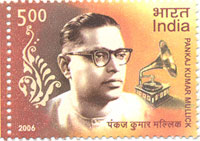
-Satish Chopra
‘Gujar
gaya wo zamana, kaisa kaisa’,
as and when
we listen to these grand nostalgic signatures of the melody of the gone by days;
something, which cannot be put to words, erupts in the head and heart of
millions of music lovers. Was this
melody sung and composed by Pankaj Mullick for the film ‘Doctor’ (1941), a mere
song? Certainly
not.
It was
indeed more than a song to be evaluated, as
the music had a wonderful
expression of thought immersed in the lyrics, the musical instruments deployed,
the complete control over the tonal
quality of the singer and above all its magical spell on the listeners. And,
this was just a glimpse of the music of one of the greatest singers and
composers of the last century.
Pankaj
Mullick was born in a middle class family on 20 April, 1904 in Calcutta. He had
a deep interest in music from his early childhood days. As he could not afford
to buy a harmonium, he borrowed one from his neighbor, who was away to Iraq. He
had his early lessens in music from Durgadas Chatterjee, followed by Laxmibai
Mitra (for Robindra Sangeet) and Dinendranath Tagore.
In view of
early demise of his father and consequent economic constraints, he could not
complete his college education. However, he carried on with his music training.
He was thus destined to be a singer and a composer! Thereby, making his first
recording disc for Beelophone Company in the year- 1926.
In the
year-1931, Pankaj Mullick joined the renowned music director, Rai Chand Boral
for the orchestral music, under the banner of International Film Craft and
jointly composed music for films ‘Chesher Meya’, ‘Chorkata’ and ‘Dena Paona’ in
Bangla.
He was
perhaps the first to introduce Western Classical orchestral music in films and
or otherwise, besides keeping the flavor and tang of traditional Indian
character intact. He, as a result,
successfully accorded new dimensions to the vocal cord of the singers.
At
All India Radio,
Punkaj Mullick taught music to song
loving pupils, which was a celebrated job in those days. He as well
wrote books on music,
such as -‘Geet Balmiki’, ‘Raag Lakshan’, ‘Geet Manjan’ and ‘Mahishasur
Mardan’. Besides, he acted in films- ‘Dhartimata’, ‘Kapaal Kundala’ and
‘Nartaki’.
As he had a
deep understanding of literature, he could explore qualitative feelings in
singing while composing; be it was
K.L. Saigal, Kanan Devi, K.C. Dey or he himself and or any other singer of his
era. Thus creating an effortless
immortality in his melodies.
Pankaj
Mullick composed music for an all time great film -‘Yahudi ki Ladki’ (1933)
starring K.L. Saigal & Ratanbai. Its songs – ‘Lag
gayee chot karejwa pe’, ‘Laakh
sahee ab pee ki batiyan’, ‘Yey
tassaruf allah allah’ sung by
Saigal continue to haunt the music listeners. And, the ghazal of
Ghalib -’Nukta
cheen hei gamey dil’ sung by the maestro (Saigal) for the film is till
date considered as a marvel in the field of ghazal singing. What better
style of ghazal recitation one can expect?
It is a lessen not only for the singers but also for the listeners. By
all standards the piece of music sets up a base to evaluate, a qualitative
ghazal singing and how to effectively
communicate poet’s creation and its recitation. The composer shaped a benchmark,
by which after listening to the melody, it appears that the poet (Mirza Ghalib)
has come alive!
The film
-‘Mukti’(1937) starring P.C. Barua & Kanan Devi is another milestone in the
career of Pankaj Mullick. Its enthralling music with the shades of
Robindra Sageet was simply
amazing. Listen to Kanan Devi- ‘Kaisa
ujrha chaman kisi ka’,
‘Kaun desh hei janaa’ & ‘Sanwariya mun ayaa re’
and Pankaj Mullick, himself
when he sings ‘Kaun desh hei janaa,
babu’ & ‘Sharabee soch na kar
matwaley’. The entirety enriches the grand nostalgic treasure of cine
music!
In
‘President’ (1937) though the music
was composed by Rai Chand Boral, but a melody lover cannot escape his
attention from the orchestral effects
contributed by Pankaj Mullick for the film.
‘Duniyaan
rang rangelee baba, duniyaan rang rangelee rey’
a duet of
film ‘Dhartimata’ (1938) is one of most popular songs of the century. There are
two versions of this epoch-making recording, one better than the other. In
soundtrack portrayal of the film, the song
was sung by K.C. Dey, Umashashi and
K.L. Saigal, while in the other (gramophone-record) version,
it was in the voices of Pankaj Mullick, Umashashi & K.L. Saigal. The fact
remains that the composition of Pankaj
Mullick in both the forms, is simply fabulous. And, there was another bewitching
song of Saigal in this film- ‘Ab
mein kah karoon kit jaun’. In
the song the depth of the singer’s
voice cannot be put to words, it can simply
be felt and experienced. Whenever a music-listener needs a deep solitude.
I feel that there cannot be a better substitute than this everlasting melody.
The music
for another prominent film composed by the maestro was ‘Dushman’ (1939) starring
K.L. Saigal & Leela Desai. In this venture also
when Saigal sings- ‘Karun
kya aas niraas bhayee’, ‘Preet
mein hei jeewan jokhon’, and another two
numbers, the impact is simply fabulous. The soul of the lyricist Arzu Lucknavi
appeared entirely different! .
The songs
sung by the maestro himself- ‘Piyaa
Milan ko janaa for film- ‘Kapaal Kundla’ (1939); ‘Yey
kaun aaj ayaa, sawerey sawerey’, ‘Madh bharee rutt jawaan hei’ & ‘Prem ka
nataa chhutaa’ are some of the rare gems for listeners who cherish the music
for the soul.
“The film
‘Zindagi’ released in the year-1940 starring K.L. Saigal, Pahari Sanyal &
Ashalata will not be recognized for its legendary director -P.C. Barua, nor
for the production-banner of ‘New Theatres’ of Calcutta; but will be
remembered for the songs sung by K.L.Saigal and its music composed by Pankaj
Mullick,”- thus wrote the flamboyant editor,
Baburao Patel in April 1940
issue of
‘Filmindia’- while reviewing the film after its release.
Listen to
some of the greatest melodies of the century for this film- ‘Mein
kya janoo kya jadoo hei’, ‘So
jaa rajkumari’, ‘Deewana
hoon, raahat sey mein beganaa hoon’ & ’Jeevan
asha yey hei meree’. The heart-throbbing style of singing- ‘Kya jadoo
hei’ of wordings immersed in the song- ‘Mein kya janoo__’, and the
way it was composed; further requires a deep sense of imagination to appreciate
the music. In ‘So jaa
rajkumari’ singing, the singer and the composer have created one of the
greatest lorees (lullabies) in the annals of film music.
Interestingly, the lyricist Kidar Sharma initially wrote this loree as
‘So jaa Rajdulari’ as an offering in a casual manner to his wife, Rajdulari.
But, for the song, it was altered to Rajkumari.
Pankaj
Mullick will always be recognized
for composing and singing
songs for the film- ‘Doctor’ (1941) which bears his complete signatures.
The full throated voice quality in rendering- ‘Aayee bahaar’,
loveable impact on the listener in- ‘Mehak
rahee phulwari’, ‘Chaley
pawan ki chaal’, ‘Aaj
apni mehanton ka humko tamga mil gaya’ and amazing western orchestral
instrumentation in ‘Pran chahey nein naa chahey’ - all such factors
established the maestro as a truly
genius singer and a composer.
The
paramount of the career of the maestro as composer came in film ‘My Sister
(1944) starring K.L.Saigal. Just have a listening to four golden melodies,
sung in four
different styles by one and only-
K.L. Saigal- ‘Do nainaa
matwaley’, ‘Chhupo na
chhupo na’, ‘Aye
quatibey taqdeer’ & ‘Hayey
kis but ki muhabbat mein giraftaar huyey’.
A casual
hearing to these captivating numbers, will certainly prove as a love at first
sight! If not, there is some thing
wrong with the listener.
Looking to
the acclaim received from first three numbers viz ‘Do
nainaa matwaley’, ‘Chhupo
na chhupo na’ & ‘Aye
quatibey taqdeer; Pankaj Mullick recorded these three songs in his own
voice, which is indeed a collectors’ treasure.
A question
generally arises amongst the
listeners, as to who sang better these three songs? Though, apparently it looks
irrelevant, like comparing different flowers. A rose is a rose, like a jasmine
is a jasmine. But, the fact remains that what Saigal sang; it will be remembered
for times to come. But, nobody can predict about the other.
The chapter
on Pankaj Mullick will be incomplete, if a reference to his own non-film songs
is not made. The list of such numbers include- ‘Yey ratein yey mausam yey
hasna hasana’, ‘Terey mandir ka hun deepak jal rahaa’, ‘Pran chahey nein na
chahein’ & ‘Yaad ayey ki na ayey tumhari’.
In these fabulous melodies, the singer has secretly created an
ambience of a class and further explored the fascinating
feelings immersed in the lyrics.
Some of the
other films, in which he composed music were- ‘Meenakshi’ (1942), ‘Oonch Neech’
& ‘Ajangarh’ (1948), ‘Manjoor’
(1949), ‘Roop Kahani’ (1950), ‘Chhoti Maa’, ‘Yatrik’ & ‘Jaljala’ (1952), ‘Naya
Safar’ (1953), ‘Chitrangda’ (1954) and ‘Kasturi’
-with Jamal Sen (1954).
Pankaj
Mullick for his meritorious contribution to Indian cinema,
was awarded ‘Padma Shee’ in the year 1970 and the prestigious
‘Dada Saheb Phalke Award’ (the highest for contribution to Indian Cinema)
in the year 1973, besides the coveted ‘Sursaagar’.
Leaving
behind the haunting lines, he once rendered- ‘Yey kaun ayaa sawerey sawerey’
and an aura; the maestro breathed his last on 10 February, 1978.
-Satish
Chopra, BA/26B-Ashok Vihar-I, Delhi- 110052 #011-27134229/8802805055
Emailsatishchopra@rediffmail.com