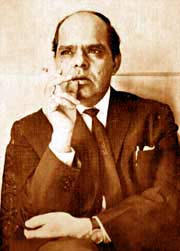
The light of music: Roshan
-Satish Chopra
‘Khayalon
mein kisi ke is tarah aya nahin karte’
sung by Mukesh and Geeta Roy for film- ‘Bawre Nain’- starring Raj Kapoor and
Geeta Bali- in the year 1950 is still alive in the head and heart of millions of
nostalgic music lovers world over. As and when, the unforgettable melody is
played, the listener derives a different kind of soul throbbing experience,
which somehow cannot be put to words.
The reason-
singing at ease, simple lyrics and above all captivating and charming
instrumentation of its music by an almost unknown melody maker called- Roshan
Lal Nagrath- more popularly known as Roshan.
The utmost
trust of Kidar Sharma, the producer of the film in the composer’s maiden failure
in his earlier venture ‘Neki aur Badi’ in the previous year was somewhat unheard
of in the annals of history of mankind. More particularly in present day rat
race for accumulating wealth. Such gesture on the part of one and only- Kidar
Sharma needs a particular reference, before commenting on the music and persona
of Roshan.
After
serving All India Radio, Delhi station for ten years as a class dilruba player
and an instrumentalist besides a love affair and second wedlock with his
trainee- Ira Moitra (a Bengali). Roshan, reached Bombay in search of some job
assignment as a music composer. The place to stay was a garage of Husnalal (of
Husnalal Bhagatram- duo). It was this garage, where his fist son Rakesh was
born.
A
coincidence! At Dadar station, he came across Kidar Sharma, the renowned
producer-director, who was planning his next film- ‘Neki au Badi’ (1949). He
somehow imposed his trust in Roshan for the film by replacing Snehal Bhatkar.
The film
proved a failure and the dejected and a highly sensitive Roshan one day came to
his mentor- Kidar Sharma fully charged with emotions, sobbing and in tears. He
told- “Sharmaji mein khudkushi karna chahta
hoon” (Sharmaji, I want to commit suicide).
In one of
his interviews, Kidar Sharma while narrating this incident narrated that after
patiently listening to Roshan, he told him that as regard his intention of
committing suicide is concerned, he has no objection. At the same time, he asked
him to let him know- if he would like to be drowned in Haji Ali or he should
take his to Varsova, where there is better water-level.
“It will be
your choice and in the matter of your decision of committing suicide, he will
not come in the way.”-added Kidar Sharma. On the contrary, he assured him that
he will give him another chance in his next film- ‘Bawre Nain’.
As a
visionary he could visualize a lot of hidden talent in Roshan. Thus, the suicide
attempt of Roshan was averted; but the fact remained that during such period of
mental distress, the composer in Roshan created the alluring- ‘Teri
dunian
mein dil lagta nahin, wapas bula le main sazde
mei’ -later on sung by Mukesh for film Bawre Nain.
Before
commenting on the grand success of Bawre Nain, I would like to narrate another
incident, which occurred during the course of its making. Kidar Sharma in his
interview to the brilliant Radio broadcaster, Ameen Sayani once told- “One day
Mr Dondh, a film distributer from Indore came to my office, when Roshan was
already there. He put a bundle of Rs. Fifty thousand on my table and told me
that he would also give me another Fifty thousand for an additional
territory of East Punjab for the forthcoming film ‘Bawre Nain’ on the condition,
if I replace Roshan and instead engage- Husnalal Bhagatram for its music”.
“Roshan, who
was sitting in the same room, on listening to these words, immediately left the
room”, added Kidar Sharma- “I, too, left the room, leaving behind Mr Dondh and
went to the adjacent room, where I saw Roshan sobbing with tears.. He (Roshan)
told me- ‘Sharmji aap Husnalal Bhagatram ko le
lijiye, jis-se aapka pachhees hazar bhi bach
jayenge’”. (Sharmaji, you please engage Husnalal Bhagatram in my place, thus
you will save twenty five thousand rupees).
“I came back
to my room, where Mr. Dhondh was sitting. Though in my life, at one given
moment, I had never seen such big amount of money; I gave him back the bundle
containing Fifty thousand and told him that his conditions are not
acceptable to me and further said that it is like insisting me to change my wife
for a ransom”.
This is how
the journey of music of Roshan commenced. In ‘Bawre Nain’, he composed some
bewitching melodies. ‘Kyoun mere dil mein’, ‘Muhabbat
ke maron ka’- sung by Rafi;
Ghir ghir ke
aasman par’ & ‘Sun
bairi balam
mat bol’ –sung by Rajkumari and ‘Mujhe sach sach
batado, kya’-sung by Mukesh & Rajkumari;
In the
following year came another classic musical hit film- ‘Malhar’, wherein again
Mukesh sang some fascinating numbers for Roshan. How can a music lover forget-
‘Dil
tujhe diya tha rakhne ko’ & ‘Hota
rahaa yun hi’ (solo) and two duets- ‘Bade
arman se rakha
tha’& ‘Ik
baar agar tu keh de’- sung by Lata and Mukesh.
Besides, the film’s title music ‘Garjat
barsat sawan aayo re’ – sung by Lata,
based on raag malhaar. Somewhat identical lyrics were repeated in another
title music for ‘Barsat ki Raat’, which was sung by Kamal Barot and Suman
Kalyanpur.
This was the
period, when Indian film industry had a galaxy of music composers and each one
of them wanted to give something better than the other. Amongst the front liners
were- Anil Biswas, Naushad, Husnalal Bhagatram, Shanker Jaikishan, Hemant Kumar,
S.D, Burman. C.Ramchandra, Vasant Desai, Ghulam Mohammad. O.P. Nayyar and
Khaiyyam- just to name a few. And, music during those days was one of the prime
factors for the success of a film. As such, for a new composer, it was very
difficult to survive in the industry, if music of the film released was not to
the expectations of its viewers. In view of such grand music of the decade- 1951
to 60, the period was named as the ‘Golden Era’ of Indian cinema. And, certainly
was not lacking, as he proved his worth.
Back to his
early days at Gujranwala (Punjab) where he was born on 14 July, 1917, Roshan had
little interest in his studies. But he could play harmonium at ease. He quit his
schooling at an early stage went to Shahjahanpur (near Lucknow), where his
father was serving. It was from this stage that he had an opportunity of
learning though for a short while from the legend- Ustad Allaudin Khan, the
doyen of Maihar gharana and father of renowned sarod maestro Ali Akbar Khan and
Annapurna Devi. Such training proved to be of an immense value for his future
course of music career.
Roshan as
well studied at Marris College, Lucknow (later on known as Bhatkhande College of
Music) and had an opportunity of learning music from Pt S.N. Ratanjankar. After
such training at Lucknow, Roshan came to Delhi, where he met the grand singer in
offing- Mukesh. Both became very close friends. In view of such proximity of
their friendship, Mukesh sang some of his best songs for Roshan.
As stated
here-in-above, after serving All India Radio, Delhi for ten years and having his
second wedlock, he arrived in Bombay. His maiden attempt was a failure, but the
trust imposed by Kidar Sharma proved a grand success in his second attempt for
his film ‘Bawre Nain’. This is how the narrative progresses.
In this
films- ‘Malhar’ released in the year 1952, Roshan composed some alluring
melodies- ‘Bade armanon
se rakha hei
sanam teri kasam’, ‘Ik
baar agar tu keh de’ & ‘Kahan ho tum’- duets by Lata
Mangeshkar and Mukesh; ‘Hota
rahaa yun hi agar’, ‘Tara
toote duniyan
dekhe’ & ‘Dil
tujhe diya tha rakhne ko’ –three
memorable solos of Mukesh; ‘Koyee to sune mere dil ka fasana’ & ‘Mohabbat
ki kismet banana se pahle’ –solos of Lata Mangeshkar.
Moreover, there was a captivating classical title song –‘Garjat
barest bheejat’. Equally well, here were some fascinating compositions
for film ‘Hamlog’ (1952)- ‘Chhun
chhun baaje payal mori’ & ‘Chalee
chalee ja chalee ja chhod ke duniyan’
–solo by Lata Mangeshkar; ‘Apni
nazar se unki nazr tak’ & ‘Dil
ki pareshanian ishq ki veeraniyan’
–sung by Mukesh and ‘Gaaye
chalaa ja gaaye chalaa ja’ –duet
by Lata and Durrani.
There were
four everlasting melodies of Lata Mangeshkar for the film ‘Naubahar’ (1952)-
‘Aree
mein to prem diwani mora dard na jaane
koye’, ‘Dekho
jee mora jiya churaye liye’, ‘Wo
paas nahin majboor hei dil’ & ‘Unke
bhulane pe bole mera di’. These songs are still fresh in
the head and heart of ardent music lovers. The charm of the throat of Rajkumari
was very much visible in her number- ‘Kajrari
matwari madbhari akhiyan’. Though a ghazal by
silken voice quality of Talat Mehmood- ‘Kisi
soorat lagi
dil ki’ made the film, a mile stone in career history of
the maestro. Roshan composed tet another classical classic ‘Aye
ree aalee
piya bin’ –sung by Lata Mangeshkar for film ‘Raag Rang’ (1952).
Kidar Sharma
produced and directed a film ‘Rangeen Ratein’ (1956)starring Shammi Kapoor and
his charming wife Geeta Bali and Roshan provided the music. A duet of Mohd Rafi
and Lata Mangeshkar –‘Bahut
assaan hei chilman se laga kar muskura
dena’ became an instant hit. In film ‘Aji Bas Shukriya’ released
in the year 1958, Lata sang –‘Saari
saari raat teri yaad sataye’
which certainly is one of her finest numbers.
In the
career-graph of Roshan, the year 1960 was perhaps the most prosperous and
popular. It was certainly in view of the release of his all time great- ‘Barsat
Ki Raat’. The cine goers went to cinema halls time and again not merely to
see the film, but to enjoy and listen to its qawwallies. How can one forget
these charismatic qawwallies for the film- ‘Naa
to karwan ki
talash hei__ye
ishq ishq hei ishq’- sung by Manna Dey,
Asha Sudha Malhotra, Shiv Dayal Batish and others which was recorded in on both
sides of two 78 rpm records. The composition proved to be the most popular
qawwally in the annals of the history of Indian cine music- in view of its
captivating rhythm, lyrics, instrumentation and the total effect. Besides this,
there were other two numbers- ‘Nigahein
naaz ke ’ -sung by Shanker Shambhu, Asha, Sudha
Malhotra & others; and ‘Jee
chataa hei jee’ –sung by Balbir, Asha, Sudha
Malhotra & Bande Hasan. In addition to these qawwallies, there were few other
fascinating melodies, which made the film a perfect musical hit for all the
times to come. How can a music lover forget- ‘Zindagi
bhar nahin bhoolegi wo barsaar ki
raat’ –sung by Lata Mangeshkar and Mohad Rafi; ‘Maine
shaayad tumhein,
pelhe bhee kahin dekha hei’ – Rafi. Above
all the classical classic title music- ‘Garjat
barsat sawan aayo re’ – sung by Kamal Barot and Suman Kalyanpur. The
orchestrisation for this number was simply superb. Just listen to captivating
use of jaltarang and sarangi, besides all other instruments deployed. Certainly,
in this captivating number, Roshan was at his best.
The musical
journey continued and in the film ‘Aartee’ (1962), there was a appealing solo of
Lata- ‘Aapne
yaad dilaya’ and ‘Ab
kya misaal doon’ - of Rafi and a duet -‘Baar
baar tohey kya samjhay’.
‘Dil Hi To
Hai’ (1963) was anotheer splendid film. Manna Dey sang one his top classical
favorites- ‘Lagaa
chunri mein daag’, Lata -‘Dil
job hi kahega
maneige’, Mukesh - ‘Tum
agar mujhko
na chaho to koi baat nahin’ & ‘Bhoole
se muhabbat
kar baithe nadan tha bechara’ and
there was a qawwally of Asha and others- ‘Nigahein
milanein ko jee chahta hei’ and
another one by Manna Dey, Asha and others- ‘Parda
uthe salaam ho jaye’.
The film
‘Tajmahal’ (1963) was another milestone in the professional career graph of
Roshan. How can a music lover forget, the immortal duet of Lata Mangeshkar and
Mohd Rafi- ‘Jo
wadaa kiya
wo nibhana padega’ ? There were two solos of
Lata and Rafi- ‘Julmein
ulfat pe log’ . The maestro was conferred the
prestigious ‘Filmfare’ award.
The passion
of Kidar Sharma for human mental conflict and the story line of Chitralekha,
which motivated him to produce yet another version of the film. It was based on
the novel of Hindi laureate- Bhagwati Charan Verma.
This time
Roshan was its composer. Earlier, he produced and directed ‘Chitralekha’ in the
year 1941 and Jhande Khan provided the music. One of its its successful song-
‘Tum jao jao’ is always placed in the list of ‘Sentimental
Era’. As such, though an established composer, it was an ordeal for Roshan; as
he was working for his mentor and his paramount conviction.
The music
once again was enthralling. The deep rooted lyrics of Sahir Ludhianvi- matching
with the conflicting mental agony was remarkably alluring. Two solo songs of
Lata and Rafi- ‘Sansaar
se bhage
phirtey ho’ and ‘Man
re tu
kahey na dheer dahrey’ respectively proved
somewhat unique. And there was a classic- ‘Kahe
tarsaye jihra’ sung by Usha Mangeshkar and Asha and
another classical of Lata- ‘Aali
ree roko na koi’ -were added masterpieces.
Manna Day’s
characteristic style of singing was once again visible in ‘Dooj Ka Chaand’
(1964) when he sang- ‘Phul
gendwa na maaro, lagat karejwa pe chot’.
In ‘Bheegi Raat’ (1965) as well, Lata and Rafi individually sang an instant hit
- ‘Dil
jo na keh sakaa, wohi raze dil kehne ki’.
The stage
poet Neeraj offered some of his trendy lyrics for the film- ‘Nai Umar Nai Fasal’
(1965) and Roshan provided the music. Rafi sang.-‘Karwaaan
gujar gaya’ & ‘Aaj ki raat badi
natkhat hei’ and Mukesh –‘Dekhtee hi na raho aaj
darpan na tum’. And for film Dadi Maa (1966) Manna Dey and
Mahender Kapoor sang –‘Usko
nahin dekha hamnein magar’ as well proved
some successful numbers.
Mamta (1966)
was certainly a landmark in the musical journey of Roshan. In this film; he
provided some of his well acclaimed melodies. Lata once again sang some of the
stirring classics-‘Rahein
na rahein ham’, ‘’Rehte
the kabhi
unke dil mein’, ‘Sakal ban magan pawan’ & ‘Vikal
mora manwa un bin haye’. Also a poignant duet of
Hemant and Lata –‘Chhupa
lo yun
dil mein pyar mera, jaise mandir mein
lau diye ki’ made somewhat emotive impact on the
viewers.
In film
–‘Bahu Begum’ (1967) the composer provided a few popular melodies ‘Parh
gaye jhoole sawan rut aayee re’ – Lata, Asha and
Rafi and ‘Ham Intzaar
karenge kayamat tak’ and in Noorjehan released
in the same year, Suman Kalyanpur sang –‘Sharabee
sharabee’ which were well admired.
A heart
patient for almost twenty years and a hypersensitive the maestro died in Bombay
on 16 November, 1967 leaving behind his first name-‘Roshan’, as surname for his
sons- Rakesh and Rajesh and thereafter for his grandson- Hrithik.
This was
perhaps in continuation to the tradition of gaining recognition at an initial
stage by using their father’s name- as being adopted by Amitabh Bachhan, who as
well adopted his father’s pen-name ‘Bachhan’ as his surname.
Nitin Mukesh
and his son Neel Nitan Mukesh likewise used their surname of their father
and grand father’s first name ‘Mukesh’, whose name was Mukesh Chand Mathur
What an
irony!
This was the
same Roshan Lal Nagrath, who determined to commit suicide after his maiden
failure of the film ‘Neki Aur Badi’ in the year 1949.
When he
died, last released film ‘Anokhi Raat’ starring Sanjeev Kumar was in
making, wherein Mukesh sang –‘Oh re taal mile nadee ke jal
mein, nadi mile sagar mein, sagar mile kaun se jal mein
koi janey na’.
- Satish Chopra,
BA/26B Ashok Vihar-I, Delhi-110052 #011-27134229/8802805055
Email: satishchopra@rediffmail.com