In search of a genius:
Shyam Sunder
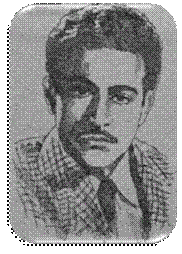
-Satish Chopra
Thirty five years after the partition and two wars between India and Pakistan;
in the year 1982 the melody queen, Malika-e-Tarannum Noorjehan visited
India. It was certainly a grand occasion for millions of music lovers of Indian
sub-continent.
In her honour and to facilitate nostalgic music lovers, in Sanmukhanad Hall,
Noorjehan came to the dais with a thunderous applause from the jam-packed
auditorium and after a brief speech; as expected, she sang her most popular
melody-
Awaaz de kahan hei,
dunian meri jawan hei she recorded in India for film ‘Anmol Ghadi’
- Music was composed by Naushad.
Thereafter, it was Lata to sing, who found herself in a very difficult situation
owing to a completely charged atmosphere
all around the auditorium. She kept every one guessing about the selection of
her song.
Lata came out with one of her endearing melodies -
Saajan ki galian chhod chaley,
dil roya aansoo beh na sakey from
film ‘Bazaar’ music for which was composed by Shyam Sunder. The applause was
beyond imagination. The memory of the completely forgotten genius music director
Shyam Sunder came alive, when in her next round Noorjehan sang –
Baithee hun teri yaad ka ley
karkey sahara another immortal melody from film - ‘Village Girl’,
music for which was composed by none other than Shyam Sunder.
The audience was indeed spell bound. Every one thought as to why she chose a
completely forgotten Indian melody instead of a large number of songs she
recorded in
The momentous event continued with lots of nostalgic and tearful exchanges and
it became a history in the annals of pre and post partition Indian art, culture,
music and all such related aspects of humane!
A period of another more than twenty six years has since passed, but memories of
these two immortal melodies composed by Shyam Sunder besides many others; at
times, create a typical restlessness in the head and heart of a large number of
candid music lovers.
Why such a legendary music- composer has completely been forgotten? Who composed
music for some of the classics of his time, such as ‘Village Girl’- 1945,
‘Devkanya’ 1946, ‘Actress’ and ‘Ek Pal’-1947,
‘Bazaar’ and ‘Lahore’- 1949, ‘Dholak’, ‘Kale Badal and Alif Laila’ -1951
just to name a few.
Down memory lane, it was the year 1938 K.L. Saigal visited
As such, before the commencement of the show, Mohammad Rafi, the young lad who
came from a nearby village, sang a few songs in Punjabi without a mike. He was
appreciated by one and all, including Shyam Sunder and Saigal.
Subsequently, when a Punjabi film named ‘Gul Baloch’ was produced and its music
was composed by Shyam Sunder, young Mohammad Rafi
recorded his first song (in Punjabi)-
Soniyo nee,
heeriyo nee.
In the years to follow, the collection of melodies composed by Shyam Sunder is
embedded with some rare gems. To commence with, let me introduce the readers
with some of his fabulous numbers. In the year 1943, he composed music for film
‘Nai Kahani’. An alluring song of G.M. Durani and others–
Neend hamari khwab tumhary,
kitney meethy kitney pyary which
became an instant hit.
Even today after a gap of more than
sixty years, the melody richly deserves an eloquent place in the list of popular
melodies of yesteryears.
In his next film ‘Village Girl’ -1945,
Shyam Sunder came with
flying colours, wherein Noorjehan sang some of her fabulous
melodies viz–‘Baithee hun teri yaad ka ley
karkey sahara, ‘Kis tarah bhulega dil’
& ‘Sajan pardesi, balam pardesi’.
In these vital numbers, the feelings immersed in the lyrics -written by Wali
Saheb- she was in her complete command. The singer did not merely sang the words
inscribed in the lyrics, but the depth of feelings. The class of accompanying
instrumentation and the matching orchestration was superb and genius of the
composer was distinctively visible.
It is needless to reiterate that as and when a list of immortal melodies of
previous century of Indian sub-continent in general and Noorjehan in particular
will be drawn; these numbers will invariably find a prime place, music for which
was composed by a totally forgotten genius called- Shyam Sunder.
Again, it will not be out of place to record that Noorjehan continued to sing
after leaving Bomaby and migrating to
Coming back to the music of maestro- Shyam Sunder after the exit of Noorjehan
from Indian film music, there came film
‘Actress’ in the year 1948, wherein
Mohammad Rafi gave his initial
introduction to music world by singing –
‘Hum apne dil ka fasana unhein suna na sakey’ . This proved
to be Rafi’s initial introduction. .
The film ‘Bazaar’ released in the year 1949 was certainly a class, in view of
its musical hits. Listen to some of the fascinating melodies of this film-‘Sajan
ki galian chhod chaley, dil roya aansu beh na sakey’ & ‘Basaa lo apnee nigahon
mein pyar thorha sa’ (Lata
Mangeshkar), ‘Aye mohabbat unse milnen ka
bahana mil gayaa’ (Lata & Rafi), ‘Shahidon
tumko mera salaam’ (Rafi) and
‘Chhalla de jaa nishani teri
mehrbani’ (Rafi and Satish
Batra).
Another musical masterpiece entitled- ‘
While evaluating his music in his subsequent films viz- ‘Kamal Ke Phool’, ‘Bhai
Behan’ & ‘Nirdosh” -1950, ‘Kale Badal’, ‘Mukhra’ and
‘Dholak’ -1951, and ‘Alif
Laila’ -1951; a particular reference needs to be made of
film- ‘Dholak’, wherein Shyam Sunder
created three poignant compositions- ‘Mere
dil mein aaiyey sung by Shamshad,
‘Chori chori aag si dil mein laga
key chal diye, hum taraptey reg gaye, wo muskara ke chal diye’ &
‘Mausam ayaa hei rangeen, bajee
hei kahein surili been, aisey mein hauley hauley’ sung by Sulochana
Kadam and Satish Batra. In the last
number, the orchestration is simply great and captivating and the way
hauley hauley has been sung, it is
simply a class in itself. Such a film musical experiment can be categorized as
rarest of the rare category.
The list of his other memorable
melodies include: ‘Ik bewafa ki
yaad mein tadfa ke maar dala’-Suraiya (‘Char Din’-1949), ‘Thandi
hawa ke jhoke’ –Shmashad (‘Nirdosh-1950),
‘Ye meri chalti phirti laash’
–Lata,
‘Sazaa mili hei ye kisi ko ye
dil lagane ki’ and
Koi dil mein samaya chupke chupke’ -Suraiya
and ’Jalti hei dunia jalti
rahegi’ –Talat (‘Kamal Ke Phool- 1950),
‘Akhiyan mila ke akhiyon kineend
chura ke’ –Sulochana Kadam (‘Mukhra’ -1951),
‘Khamosh kyon ho tare, ummid ke
sahare’ and
‘Kya raat suhni hei’
–Lata & Rafi (‘Alif Laila’ -1951).
The music-creating journey and cardiograph of Shyam Sunder can be matched with
another maestro called Sajjad Husain, who also composed music for just 14 films,
but composed some of the finest melodies of his era.
Both the masters were highly perfectionists; but ill-tempered and
uncompromising.
Shyam Sunder,
additionally in view of his addiction to
liquor and excessive drinking, occasionally uttered
abusive language and consequently used
to lose control over his head and heart. During the making of the film ‘
In the year 1952, when the film- ‘Alif Laila’ was in making, Shyam Sunder died
in the recording studio, owing to excessive drinking and consequent heart
attack; the music thereby was
completed by his assistant- Madan Mohan.
-Satish Chopra,
BA/26B Ashok Vihar-I, Delhi-110052 # 27134229/0-8802805055
Email:
satishchopra@rediffmail